FOSDEM

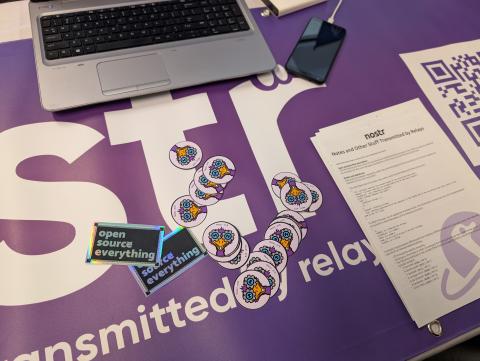
A Nostr stand submission for FOSDEM 2027
Image
Nostr stand FOSDEM

The 2025 submission: https://drive.proton.me/urls/NCW923YGA8#ro5h5d6sLViA 

The 2026 submission: https://drive.proton.me/urls/R01N7WDQ7G#vzh9PJV5BBpO 

This is the submission for a Nostr stand at FOSDEM 2027:


Project name

Nostr

Description

Nostr (Notes and Other Stuff Transmitted by Relays) is an open, decentralized protocol for signed data. Users own a keypair instead of an account; they sign events and publish them to independent relays, and every client can read them. There is no central server, no company, no token.

Most people know Nostr as a decentralized Twitter alternative. The protocol is far more general: the NIPs (Nostr Implementation Possibilities) define over 180 event kinds, implemented by independent clients, relays and libraries in many languages. At this stand, maintainers and developers show the "Other Stuff":

The protocol's reference repository has around 15,000 stars and 1,200 forks across its two main repos, and over 200 people have contributed to the specification.

Project website

https://github.com/nostr-protocol 

Source code

https://github.com/nostr-protocol/nips (Nostr Implementation Possibilities)

Project Theme

World Wide Web

Do you want a stand for the entire event or just for one day?

Entire event

Do you like to be placed next to a specific project?

Other social networking projects or communication protocols

Why do you want to be at FOSDEM?

We want to be at FOSDEM because it’s the perfect place to connect with like-minded developers and open-source enthusiasts who share our passion for decentralization, innovation, and building open, permissionless technologies. FOSDEM fosters collaboration and the growth of community-driven projects, and Nostr is a good fit as a grassroots project with an open protocol and a commitment to building communication technology with resilience and simplicity in mind.

Nostr has no company, foundation or central team behind it. The protocol grows through the people who implement it, and FOSDEM is where we find them: developers who self-host, care about open standards and are able to criticize approaches and technologies in well-founded arguments.

We want to show a side of Nostr that is rarely seen. It is not a Bitcoin project and not a Twitter clone, but a general protocol for signed data, now used for git collaboration, file storage, encrypted group chat, mesh networking and publicly funded education infrastructure. It needs no blockchain, no token and no payment to work.

Because identities are keys and content can live on any number of independent relays, no single operator can lock users out or take their data with them. We think that matters for open communication.

We also would like to talk with the other open communication protocols at FOSDEM, such as Matrix, XMPP, ActivityPub, ATProto and Delta Chat, about shared problems like spam, moderation, identity and interoperability.

Why do the people that comes to FOSDEM may watch your project?

FOSDEM visitors care about owning their tools, self-hosting, and open standards. Nostr provides them with all three for social and communication software. At our stand, people can try it hands-on: create a keypair and see the same identity, follows, and posts appear across independent apps, or push to a Git repository through ngit without any central forge.

We will also show Nostr beyond decentralized and censorship-resistant microblogging, e.g., file storage with Blossom, encrypted group messaging with Marmot, mesh networking with FIPS, or TEPP, an approach to building child-safe access to the internet, and answer questions around these projects.

Nostr provides a small set of shared building blocks: signed events, relays, subscriptions, and conventions that applications can extend. The people at the stand maintain libraries, run relays, and develop apps, so visitors can ask the people building directly and get an idea of where to start if interested.

What is the relation between the project and the primary contact?

Sebastian is an independent creative/full-stack web developer and the maintainer of the Nostr-PHP library, which was supported b a one-year OpenSats grant in 2024. Besides this project, he also contributes by developing Nostr modules for Drupal. Sebastian is also one of the co-founders of the nonprofit Web of Trust Foundation, based in the Netherlands, which is building the TEPP protocol and a YouTube Kids reference application: https://kubo.watch. Another project is Nyves (https://nyves.nl), which aims to bring back Hyves, a Dutch social network with more than 9 million profiles, using Nostr.

“Since I first went online in 1998, I've been highly interested in online communities, social networking, and new ways of digital interaction. The internet has changed radically in the last decade, and that change is not serving our interests. It's fair to say the web is broken in many ways. With Nostr, we can fix this.”

What is the relation between the project and the secondary contact?

Steffen works on open education infrastructures and connects education-related services and platforms using Nostr. He is the lead developer and maintainer of Edufeed (https://edufeed.org, source: https://git.edufeed.org/edufeed/edufeed-app), a decentralized platform for open educational resources, articles, wikis, calendar events and communities built on Nostr. The approach of connecting education infrastructures via Nostr has been funded several times by the German Federal Ministry of Education, Family Affairs, Senior Citizens, Women and Youth (BMBFSFJ, [ComCal], [edufeed], [KI-NOPE]). Steffen also develops nope-mcp (https://git.edufeed.org/edufeed/nope-mcp, live at https://mcp.edufeed.org), an MCP server that lets AI agents search and cite more than 100,000 openly licensed educational resources published on Nostr relays. Edufeed's own development happens on Nostr: issues and pull requests go through ngit (https://gitworkshop.dev/laoc.xyz).

Anything else you like to add?

We would like to attend with a group of volunteers from different Nostr projects, as we did in 2025.

Since Nostr is often associated with Bitcoin or with individual investors, we want to be clear about this: Nostr is not a blockchain project. There are no tokens and no fees, and using it requires no payment. No company owns the protocol or its specification. Development has been supported by donations from several sources, including private donors and nonprofit grant programs such as OpenSats, and by public funding for projects built on Nostr. Payment features such as Bitcoin can be added by applications, but they are optional and not part of the core protocol.

Please reach out to us if there are any questions. We are looking forward to presenting Nostr as a protocol at FOSDEM.
Tags

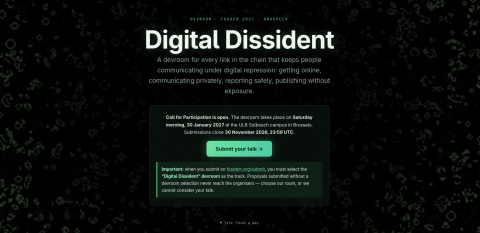
Digital Dissident devroom at FOSDEM 2027

Image
Digital Dissident devroom FOSDEM 2027

The FOSDEM 2027 devroom proposal and we are calling out for talk proposals at https://digitaldissident.tech 


The submission

https://github.com/aidik/fosdem2027-digital-dissident 

FOSDEM 2027 Devroom Proposal: Digital Dissident

> The accepted version of the proposal.


Proposal title

Digital Dissident

Session type

Devroom

Language

en

Preferred slot

Half day (any).


Elaborate description

Privacy and anonymity tools each have a home at FOSDEM: the network, security, decentralised and messaging rooms, and various main-track and lightning talks. Someone living under an authoritarian regime (Russia, Iran, China, Belarus, Myanmar and others) never uses a single tool, though. Their day-to-day security depends on a chain of tools that has to hold up end to end:

  1. reaching the network at all (censorship circumvention),
  2. communicating without leaking metadata,
  3. collecting, verifying and storing evidence safely,
  4. publishing or leaking it without exposing the author,
  5. doing all this on devices and infrastructure that are themselves a risk.

The weakest link decides the outcome. Talks about one tool rarely cover how it fits with the others, where the seams are, or what breaks at the hand-offs (for example, a circumvention transport that is fingerprinted, or a messenger whose push notifications tie your identity to a Google or Apple account). Nobody currently owns that cross-project view.

What this devroom does. It brings developers of circumvention, anonymity, messaging, publishing and whistleblowing tools into one room. It is deliberately not about any single project. Each session is judged on how well it advances the toolchain: interoperability, shared threat models, shared failure data, and shared engineering practice.

Why now. Censorship in Russia, Iran and China has grown much more sophisticated. It now includes national allow-lists and whitelist-only internet shutdowns, TLS and QUIC fingerprinting, deep packet inspection with active probing, throttling of specific protocols, mobile internet shutdowns, app-store removal of circumvention tools, and mandatory state-run messengers and "sovereign internet" routing. Anti-censorship developers have responded with pluggable transports, domain fronting alternatives, mixnets, decentralised and email-based messaging, and new obfuscation protocols. Progress is fast but fragmented. At FOSDEM 2026 the relevant talks were scattered: Vitaly Repin's "The Russian Censorship Circumvention, Tom's Traps, and Jerry's VPN: A 5-Year Journey" (Saturday, H.1302, Network track) drew a large audience, while NymVPN and Delta Chat's multi-relay messaging (both Sunday, Decentralized Internet and Privacy devroom) and other related talks ran in other rooms. A single devroom lets that audience and those speakers meet in one place.

Relationship to the existing "Decentralized Internet and Privacy" devroom. That room covers decentralised technology broadly (P2P protocols, browsers, code collaboration, key infrastructure), and censorship or anonymity is only a part of it. Digital Dissident is different: the organising principle is a user under threat and the end-to-end chain that protects them, not a technology class. We want to work with, not against, that room, and will coordinate schedules so the two don't overlap, and will point overflow speakers to whichever room fits.

Themes (details in the CfP below):

  • Censorship circumvention and transport: obfuscation, fingerprint resistance, active-probing defence, bridge distribution, resilience to protocol whitelisting and full shutdowns.
  • Metadata-resistant communication: mixnets, onion routing, decentralised and federated messengers, store-and-forward and offline-first (mesh, sneakernet, Bluetooth/Wi-Fi Direct).
  • Secure reporting and publishing: whistleblowing platforms, source protection, document sanitisation, provenance and authenticity, censorship-resistant hosting.
  • Devices and operational security: hardened mobile and desktop systems, amnesic systems, seizure and border-crossing scenarios, forensic resistance.
  • Usability and threat modelling for at-risk users: onboarding under duress, safe defaults, training, measuring what really works in the field.
  • Measurement and adversary analysis: how censors detect and block, open data on blocking events, reproducible censorship research.
  • Digital sovereignty from Big Tech (secondary theme): reducing dependence on centralised platforms, app stores, push infrastructure, cloud and identity providers, both for individuals and for civil-society organisations.

Structure. A mix of formats to keep a full room engaged across the whole session:

  • 20 to 30 minute technical talks
  • A closing open discussion on interoperability gaps and shared next steps

Programme quality. Organisers will review all submissions on technical merit and fit to the toolchain framing, and will aim for a balance of projects, regions and speakers (established projects, new projects, researchers, people from affected communities). Every talk should include an explicit threat model and an honest account of limitations.

Projects and communities we intend to invite (no commitments yet): Nym (mixnet), Delta Chat / chatmail, SimpleX, the Fediverse (ActivityPub implementations and instance operators), Nostr, Psiphon and other circumvention and VPN providers, plus Tor-ecosystem, Reticulum and mesh-networking projects, whistleblowing and secure-submission platforms, and censorship-measurement researchers. Several of these projects presented at FOSDEM 2026.

Code of Conduct. We will follow the FOSDEM Code of Conduct. In addition, talks that describe circumvention or anonymity should avoid operational details that would endanger specific users in the field.


Draft call for papers

Digital Dissident Devroom: Call for Participation

Journalists, activists, human-rights defenders and ordinary people living under authoritarian regimes face state-level surveillance and censorship. Russia, Iran and China are the best known cases, but far from the only ones. What protects them is not any single application. It is a toolchain of circumvention, private communication, evidence handling, safe publishing and hardened devices, where every link has to hold.

The Digital Dissident devroom brings those links together. We want technical talks from people who build, operate, attack and measure the systems that make it possible to communicate, report, publish and blow the whistle from a digitally hostile environment. We are not interested in promoting any one tool. We are interested in how tools combine, where they break, and what the free software community can build together.

We welcome talks on, but not limited to:

Getting online

  • Censorship circumvention protocols and pluggable transports, and how they fare against TLS/QUIC fingerprinting, active probing, throttling and protocol allow-listing
  • Bridge and proxy distribution, and keeping infrastructure alive when censors enumerate it
  • Operating during regional or national shutdowns and whitelist-only networks: mesh, satellite, offline-first and delay-tolerant approaches
  • Lessons from running a VPN or proxy service in a heavily censored country

Communicating privately

  • Mixnets, onion routing and other metadata-resistant transports
  • Decentralised, federated and email-based messaging, and their real-world threat models
  • Push notifications, contact discovery, phone-number identity and other metadata leaks in "secure" messengers
  • Interoperability between anonymity networks, messengers and circumvention layers

Reporting, publishing and whistleblowing

  • Secure submission systems and source protection
  • Document and media sanitisation (metadata scrubbing), provenance and authenticity (C2PA, signing, timestamping) without deanonymising the author
  • Censorship-resistant publishing and hosting: mirrors, decentralised storage, takedown resilience
  • Digital security workflows for newsrooms and human-rights organisations

Devices and operational security

  • Hardened and amnesic operating systems, device seizure and border-crossing scenarios
  • Forensic resistance, duress and plausible deniability features, secure backups
  • Supply-chain trust for tools distributed to at-risk users when app stores and package mirrors are blocked

People, usability and evidence

  • Usability and onboarding for users under stress, and safe defaults
  • Threat modelling for at-risk groups, including lessons from the field
  • Censorship measurement, open data, reproducible research on blocking events
  • Attacks: how state adversaries actually deanonymise and detect users, and what defenders learned

Digital sovereignty (secondary theme)

  • Reducing dependence on Big Tech platforms, app stores, cloud, push and identity providers
  • Self-hosted and community-run alternatives that survive political and commercial pressure
  • Legal and infrastructure risks of centralisation, such as sanctions, forced compliance and platform lock-in

What we look for

  • Technical depth: protocols, architectures, measurements, code and honest post-mortems
  • An explicit threat model and a clear statement of what your approach does not protect against
  • Free and open source software, or open specifications
  • Cross-project thinking: how does your work fit with others in the chain?
  • Field experience, from speakers who work with or come from affected communities, is especially valued

What we do not accept

  • Product pitches and marketing
  • Talks that only work by exposing operational details that would put users at risk

Formats: 20 to 30 minute talks


Why does this proposal fit FOSDEM?

  • Cross-project collaboration in a niche with no home. FOSDEM favours rooms that bring together many projects in areas that don't otherwise have a space. Censorship-circumvention, anonymity, secure messaging, whistleblowing and hardened-OS projects are currently spread across separate rooms, or missing entirely. This devroom joins them around one shared user need instead of one shared technology.
  • Community over corporate backing. The projects involved are mostly small or volunteer-driven, or non-profit, and nearly all are free and open source. They rarely have a conference space of their own.
  • Proven audience interest. At FOSDEM 2026, "The Russian Censorship Circumvention, Tom's Traps, and Jerry's VPN" (Vitaly Repin), "NymVPN: The First Real-World Decentralized Noise-Generating Mixnet for Anonymity" (Harry Halpin, Alexis Roussel) and "Multi-relay chat messaging & cryptographic identities with Delta Chat and Chatmail relays" (Holger Krekel, missytake) all addressed this audience, but in different rooms. Delta Chat also presented in 2025 and Nym in 2023.
  • Aligned with FOSDEM's values. Free software, user freedom and privacy are core FOSDEM themes. A conference held in Brussels, the seat of EU institutions, is a fitting place to discuss the technical reality of digital repression and sovereignty.
  • Practical outcome. The toolchain framing should produce concrete results: a shared threat-model vocabulary, documented interoperability gaps, and new collaboration between projects that have never met.

Submitters' affinity to the topic

Co-coordinators: Bogomil Shopov (Бого) and Sebastian Hagens (Sebastix), Václav Navrátil (Aida).

Bogomil Shopov (Бого) is a Prague-based open source and privacy advocate who has volunteered at FOSDEM and spoken there repeatedly. In 2026 he gave several talks, including "We d-build it, but they didn't come" in the Decentralised Communication devroom, and he has also given a closing talk in the Modern Email devroom. He also contributes to Thunderbird and OpenStreetMap, and spoke at DARK Prague on 3 October 2026 with "ARTivism: Hacking culture to defend privacy".

Sebastian Hagens (Sebastix) is a free and open source developer and tech consultant from Breda, Netherlands, with a long background in web technology and online privacy (PHP, Symfony, Drupal, JavaScript, Docker). He also does server operations and security work on Debian-based infrastructure, and writes about privacy and the open web. A long-time Drupal community member, he works on decentralised publishing, including the Drupal modules and PHP libraries that let sites syndicate content independently of any single platform. He co-organised a community stand at FOSDEM 2025 and presented "POSSE content with Drupal using Nostr" in the Collaboration and content management devroom at FOSDEM 2026.

Václav Navrátil (Aida) is a long-term open source advocate. He has worked on data sovereignty with TrueNAS for over a decade. In his own time he operates a Delta Chat (chatmail) relay and a Nostr web-of-trust relay, writes open source Delta Chat bots, and helps people to circumvent censorship with Psiphon.


Relevant URLs


Special requirements

  • Scheduling the room so that it doesn't overlap with the Network, Security, or Decentralized Internet and Privacy rooms, if possible, so the audiences can attend both.

My co-organizers

Aida - https://njump.to/npub1vy48k64f3hpn8gwzfdg550q7hhnauk3c30tz6xdr8uu7gvhp6udq6my8ca 

Bogo - https://njump.to/npub1vy48k64f3hpn8gwzfdg550q7hhnauk3c30tz6xdr8uu7gvhp6udq6my8ca 

His blog article hitted HackerNews as frontpage item 'I refuse to accept a censored Internet. Join Me at FOSDEM 27': https://news.ycombinator.com/item?id=50233929 with more than 500 upvotes and 250 comments.

Laoc42 - https://njump.to/npub1r30l8j4vmppvq8w23umcyvd3vct4zmfpfkn4c7h2h057rmlfcrmq9xt9ma

Tags

Hello from FOSDEM 2026!

Image
Nostr main talk

The Nostr stuff I'm working on for Drupal:

Tags
Subscribe to FOSDEM