
The 2025 submission: https://drive.proton.me/urls/NCW923YGA8#ro5h5d6sLViA
The 2026 submission: https://drive.proton.me/urls/R01N7WDQ7G#vzh9PJV5BBpO
This is the submission for a Nostr stand at FOSDEM 2027:
Project name
Nostr
Description
Nostr (Notes and Other Stuff Transmitted by Relays) is an open, censorship-resistant, and decentralized communication protocol designed for simplicity and resilience.
Nostr has seen remarkable adoption and growth (with a peak in 2024) within the open-source community, evidenced by over 16,000 GitHub stars, 800+ forks, and contributions from more than 400 people.
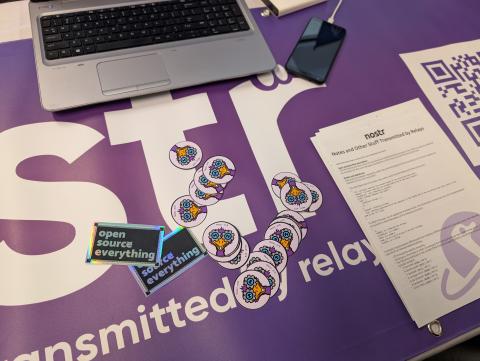
As a follow-up to our participation at the 2025 edition of FOSDEM, we want to continue raising awareness of the Nostr protocol and educating attendees on how it can be used. The protocol is still facing the challenge of finding new audiences.
While "Notes" are the first thing most people become familiar with, Nostr is not limited to being a clone of other microblogging platforms. That's why we would also like to highlight the "Other Stuff" like:
- Hashed blob files via Blossom
https://github.com/hzrd149/blossom - Distributed git using ngit and GRASP
https://ngit.dev/ - Self-organizing encrypted mesh network with FIPS
https://fips.network/ - Encrypted and private group-messaging with Marmot / Concord
https://github.com/marmot-protocol and https://concordprotocol.org/ - Creating safe and permissioned spaces with TEPP
https://weboftrustfoundation.com/protocol/
Project website
https://github.com/nostr-protocol
Source code
https://github.com/nostr-protocol/nips (Nostr Implementation Possibilities)
Project Theme
World Wide Web
Do you want a stand for the entire event or just for one day?
Entire event
Do you like to be placed next to a specific project?
Other social networking projects or communication protocols
Why do you want to be at FOSDEM?
We want to be at FOSDEM because it’s the perfect place to connect with like-minded developers and open-source enthusiasts who share our passion for decentralization, innovation, and building open, permissionless technologies. FOSDEM fosters collaboration and the growth of community-driven projects, and Nostr is a natural fit as a grassroots project with an open protocol and a commitment to building communication technology with resilience and simplicity in mind.
Why do the people that comes to FOSDEM may watch your project?
FOSDEM visitors care about owning their tools, self-hosting, and open standards. Nostr provides them with all three for social and communication software. At our stand, people can try it hands-on: create a keypair and see the same identity, follows, and posts appear across independent apps; push to a Git repository through ngit without any central forge.
We will also show Nostr beyond decentralized and censorship-resistant microblogging, e.g., with TEPP, an approach to building a child-safe and suitable access to the internet, or Edufeed, an open education platform used by German education initiatives to share learning resources, calendars, and communities across platforms.
Nostr provides a small set of shared building blocks: signed events, relays, subscriptions, and conventions that applications can extend. The people at the stand maintain libraries, run relays, and develop apps, so visitors can ask the people building directly and get an idea of where to start if interested.
What is the relation between the project and the primary contact?
Sebastian (39) is an independent creative/full-stack web developer and the maintainer of the Nostr-PHP library, supported by OpenSats through a one-year grant in 2024. Besides this project, he also contributes by developing Nostr modules for Drupal. Sebastian is also one of the co-founders of the nonprofit Web of Trust Foundation, based in the Netherlands, which is building the TEPP protocol and a YouTube Kids reference application: https://kubo.watch. Another side project is Nyves (https://nyves.nl), which aims to bring back Hyves, a Dutch social network with more than 9 million profiles, using Nostr.
“Since I first went online in 1998, I've been highly interested in online communities, social networking, and new ways of digital interaction. The internet has changed radically in the last decade, and that change is not serving our interests. It's fair to say the web is broken in many ways. With Nostr, we can fix this.”
What is the relation between the project and the secondary contact?
Steffen (36) is working in the field of open education infrastructures to connect education-related services and platforms. He is the lead developer and maintainer of Edufeed (https://edufeed.org, source: https://git.edufeed.org/edufeed/edufeed-app), a decentralized social education platform built on Nostr. Edufeed brings together open educational resources, articles, wikis, calendar events and communities, and it runs in white-label deployments for German education initiatives and as a connected infrastructure layer. Steffen also builds nope-mcp (https://git.edufeed.org/edufeed/nope-mcp, live at https://mcp.edufeed.org), an MCP server that lets AI agents search and cite well over 100,000 openly licensed educational resources published on Nostr relays. He also works on machine-readable German curricula as linked data (the MEM curriculum ontology, https://w3id.org/lehrplan/ontology/, with a SPARQL endpoint). Edufeed's own development happens on Nostr: issues and pull requests go through ngit (https://gitworkshop.dev/laoc.xyz).
Anything else you like to add?
We would like to attend with a group of volunteers to promote Nostr as a protocol and show what is being build with it, just like we did in 2025. For many of us it was the first time we attended FOSDEM and we really enjoyed it.
As an open protocol, Nostr is designed to evolve and find its own way, just like the foundational protocols of the internet. Importantly (because this often gets conflated), Nostr is not a blockchain project—there are no tokens, no costs, and no barriers. It’s also not a platform nor a NFT. It’s purely decentralized, built for resilience and simplicity. While payment solutions like Bitcoin can be integrated, they are optional, not intrinsic to the protocol. This makes Nostr accessible and flexible, truly embodying the spirit of the open internet.
Please reach out to us if there are any questions. We’re really looking forward to presenting Nostr as a protocol at one of the best places where free and open-source software is flourishing.